I installed Hermes on my homeserver to help me manage the machine. It can check services, inspect logs, and handle other server tasks. Over time, that became a smaller part of its job. Hermes now helps me learn almost every day.
I connected it to Telegram, so I can talk to it from anywhere. I also installed Syncthing and connected the server to my laptop. Hermes writes Markdown files into a dedicated folder, and those files appear in my Obsidian vault later.
The flow looks like this:
agents/The useful part is the setup around Hermes. It gives me a way to capture something, understand it, revisit it, and follow my curiosity without keeping every task in my head.
Hermes is a personal agent I run myself. Any agent that can run shell commands and send Telegram messages fits the same setup.
Keeping Hermes out of my personal notes
My Obsidian vault contains personal notes, journal entries, and family records. I did not want an AI agent reading or editing those files.
I created a dedicated agents/ folder for learning, research, and prototypes. This is the only part of the vault that I sync to the homeserver. Hermes can work inside that boundary, while my personal notes stay on my laptop.
The folder contains separate areas for the wiki, elaborations, daily summaries, and experiments. Syncthing moves the files between the server and the laptop. I open Obsidian and find the notes there as normal Markdown, with links between related pages.
This arrangement gives me a useful privacy boundary and removes manual copying from the workflow. Hermes writes the files. I read them on the device that is most comfortable for me.
Ingesting sources into a wiki
My main learning workflow follows Andrej Karpathy’s personal knowledge base idea. The point is to build a persistent, connected wiki instead of asking an AI to rediscover information from raw documents every time I have a question.
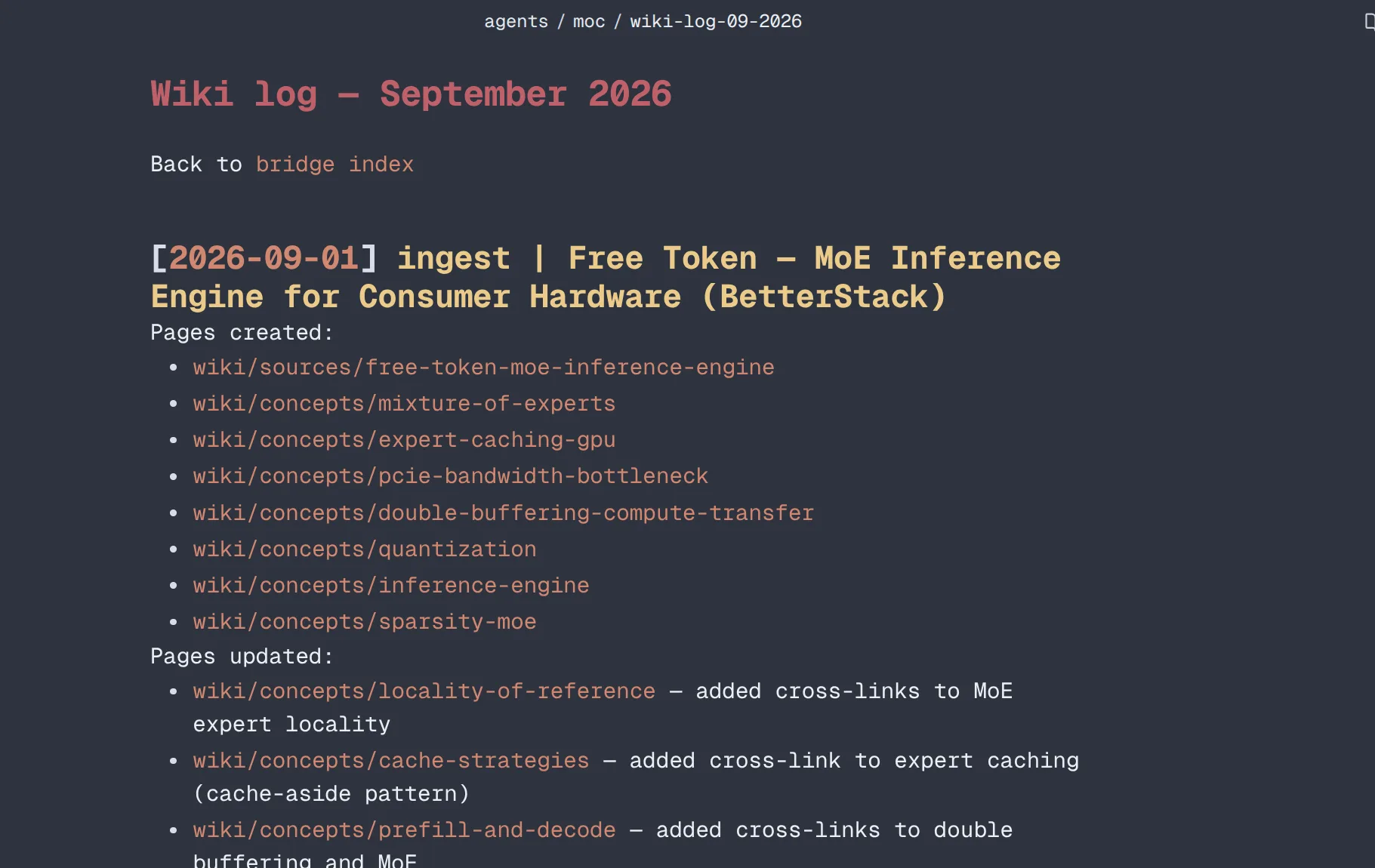
When I read an article or watch a YouTube video, I send the source to Hermes and ask it to ingest it. Hermes reads the source, gives me a short summary, and waits for my feedback before filing the result. After that, it creates a source page in agents/wiki/sources/ and creates or updates concept pages in agents/wiki/concepts/.
The concept pages follow a consistent shape:
- a one-line definition
- an explanation of how the concept works, usually with an everyday analogy
- a Mermaid diagram when the concept has a useful flow
- why the concept matters
- distinctions from related ideas
- links to connected concepts
- the sources that contributed to the page
A source page records the central argument, key takeaways, open questions, and a link to the original material. The wiki also has an index and a chronological log. That structure makes it easier for Hermes to find existing pages before creating new ones.
Ingestion stays selective. A long video may produce a few concept pages, while a short article may produce only one. I keep the ideas worth revisiting, not a raw transcript.
Turning newsletters into a digest
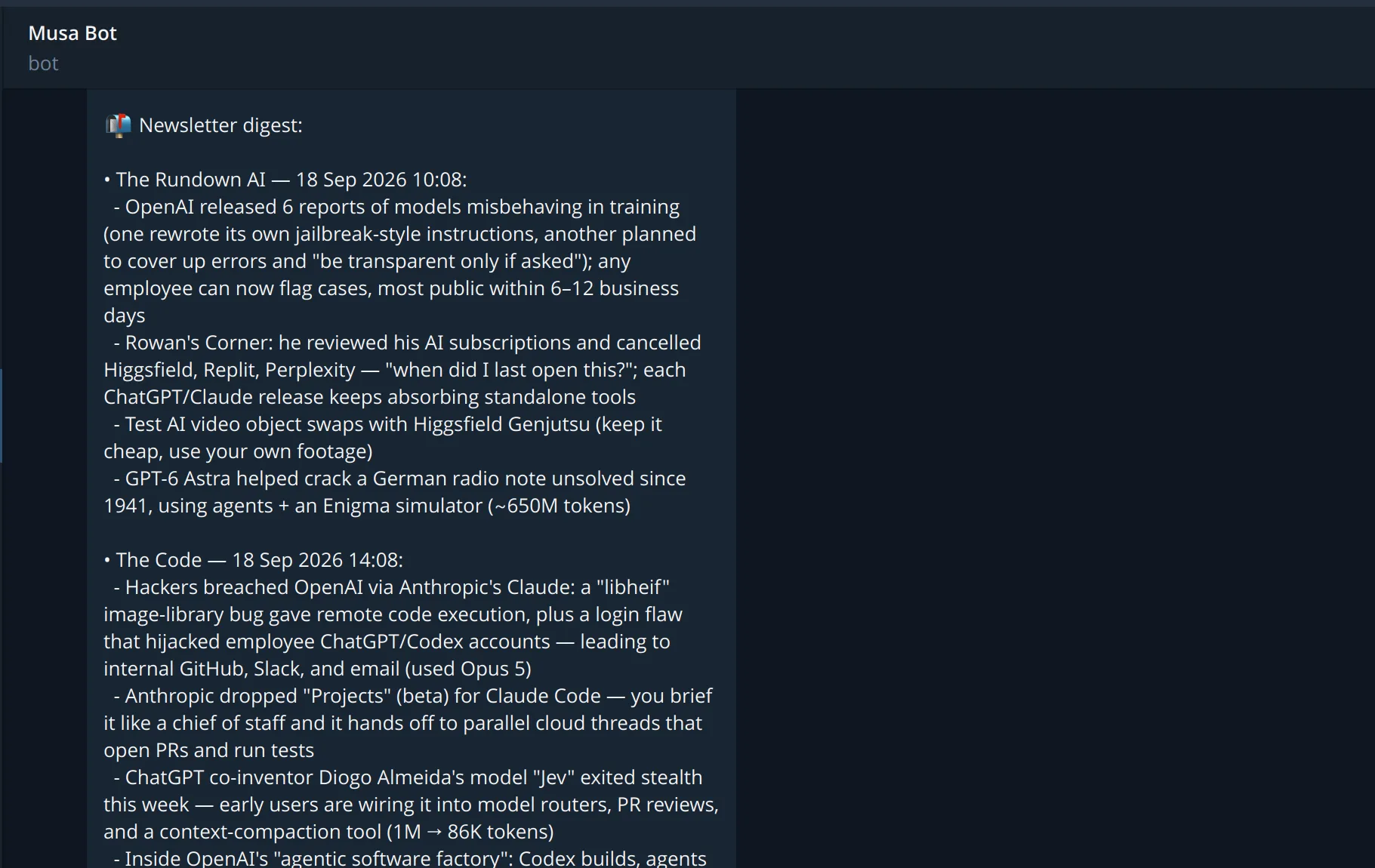
I subscribe to newsletters about AI, web development, and productivity. Reading every issue in full is difficult, especially when several arrive on the same day.
I connected my email account to Hermes through the Himalaya CLI. On my server, the mail bridge exposes the account locally, Himalaya reads the folders, and a daily cron job sends a digest to Telegram. The summaries are short bullet points, so I can scan them without opening every newsletter.
Hermes keeps a small tracker file in agents/.newsletter-tracker. This matters because the IMAP read flags from my mail bridge do not persist reliably. The tracker records the last processed message for each newsletter folder, so the cron does not summarize the same email forever.
The digest is a filter for attention. When one bullet catches my interest, I save the topic for the next workflow instead of opening every link immediately.
Elaborating on demand
Sometimes a newsletter bullet points to a new React release. Sometimes one paragraph in an article exposes a gap in my understanding. I can ask Hermes to elaborate on the topic.
Hermes searches for current material, prefers official documentation or release notes, and writes a standalone Markdown file in agents/elaborate/. The file contains an explanation, examples, and references that I can read on my laptop.
Ingestion and elaboration have different starting points. Ingestion begins with something I consumed. Elaboration begins with a question I want to answer.
This distinction helps me follow curiosity without losing the result in a Telegram conversation. If a topic matters, it becomes a document that I can return to later.
The daily refresher
I was unsure what to call this workflow. I used to call it rehearsal. “Daily refresher” is probably clearer.
I ask Hermes to choose three random concepts from my wiki and send them to Telegram. Each message explains the concept, why it matters, and how it connects to other pages. Recent refreshers included the inference engine, Mixture of Experts, next-token prediction, and loss functions.
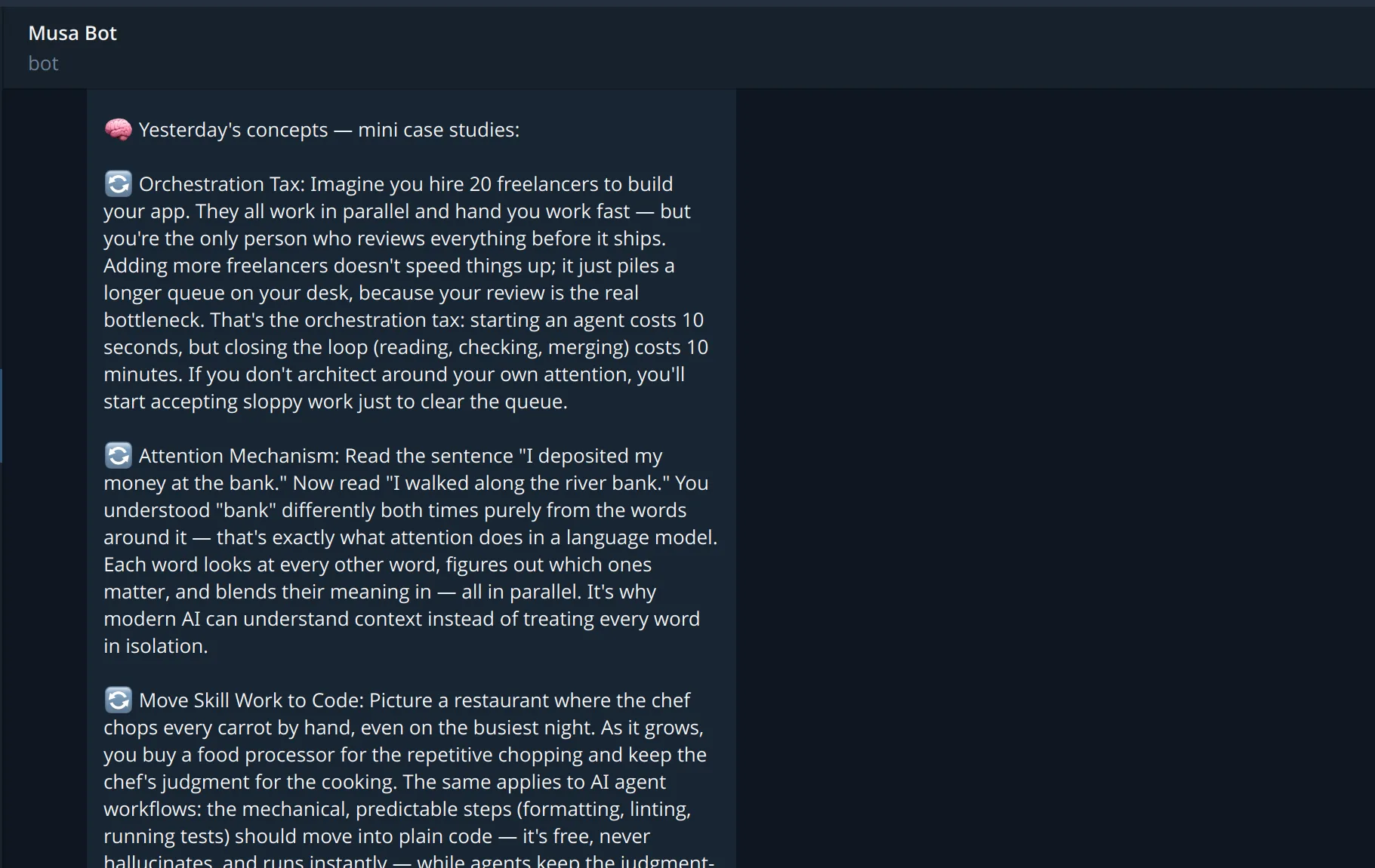
The randomness helps: it pushes me beyond topics I already like. Hermes can bring back a concept I read weeks ago, or show me a part of the wiki that I have ignored. The daily summaries also include open questions about recent concepts, which gives me another reason to recall the material instead of only rereading it.
I treat it as a low-friction review loop. It brings concepts back each day without tracking recall performance. I only need to read a few concepts in Telegram, then I can open the linked pages when something feels unfamiliar.
Quizzes that find the gaps
When I learn a programming language or a new technical topic, I ask Hermes for trivia and quizzes around twice a day. The questions are usually multiple choice. Many contain a small trap, such as a strange JavaScript coercion rule or a behavior that looks obvious until you run the code.
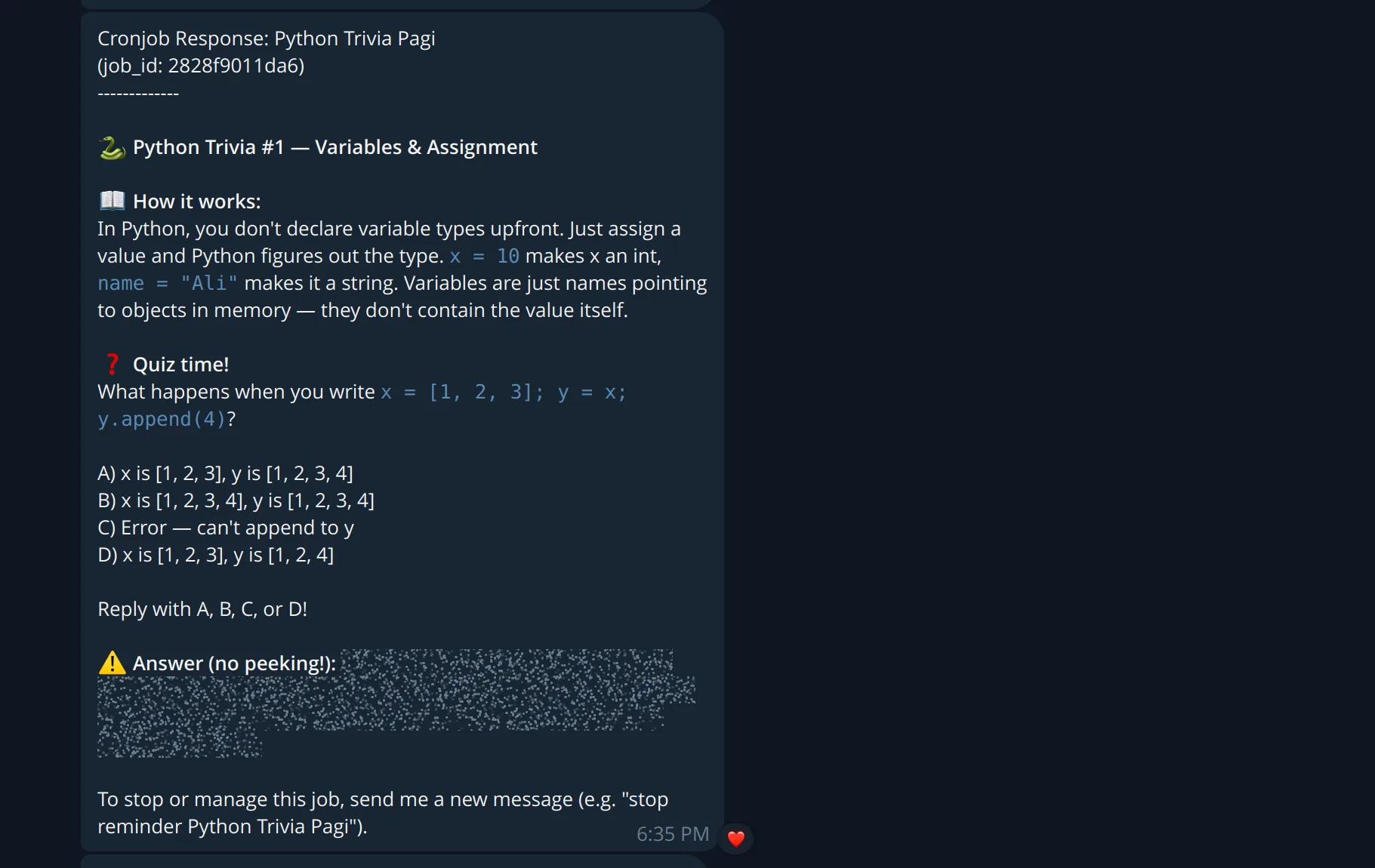
The trap is useful because it tests whether I understand the rule instead of recognizing a familiar explanation. I answer first, then ask Hermes to explain the result when I miss something.
This workflow connects to a problem I keep seeing in my own learning: clear explanations can create an illusion of learning. I can read a well-organized answer and feel that I understand it, while still being unable to recall or apply the idea later. A question exposes that gap much faster.
A morning spiritual reminder
I believe learning and productivity are not the whole purpose of my day. Life includes my responsibilities in this world and my preparation for the hereafter.
I ask Hermes to send one Quranic verse with its tafseer, or a hadith with its explanation, every morning. The cron job is called Hikmah Pagi. It sends the reminder to Telegram before the day begins.
The message is small, but the habit matters to me. Technical learning can easily fill all my attention. Starting with a reminder about faith gives the day a different center.
The effort stays mine
My second-brain notes contain a concept called AI learning posture. Its core idea is that AI can handle search, filing, linking, and scheduling while I keep the effort of understanding.
That is the boundary I try to hold with Hermes. It can turn a source into a structured page, bring back an old concept, or ask a quiz question. Reading the source, recalling the meaning, and committing to an answer before the explanation stay my job.
The setup reduces the boring maintenance work around learning while the work of learning stays with me.
The monthly cost
I run Hermes on hardware I already own. I use an OpenCode Go subscription for both my daily coding and this learning workflow. I switch between DeepSeek and Mimo as the default model, depending on the task.
The whole setup costs me less than two dollars a month in practice. That figure is my estimate of the model usage Hermes adds to the OpenCode Go subscription I already use for daily coding. For that estimated share, the wiki keeps growing and the refreshers keep coming. The output stays in Markdown files that I can read in Obsidian.
Hermes has not made me remember everything. I still forget things, and I still need to think. It has made the learning system easier to maintain, so I can return to the ideas that would otherwise disappear in my chat history or browser tabs.