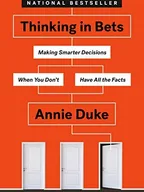
I read Thinking in Bets in 2024 and came back to it this year. The one line I kept rereading was this: the quality of a decision is not tied to the quality of its result. Poker players call the mistake of confusing the two resulting, and Annie Duke spends the rest of the book showing how expensive that mistake is.
Resulting: when the outcome lies to you
Duke opens with the 2015 Super Bowl. Seattle had the ball on the one yard line, a minute left, and Marshawn Lynch in the backfield. Everyone expected a handoff. Coach Pete Carroll called a pass instead. It was intercepted, New England won, and the next morning the press called it the worst call in football history.
The call was defensible. An incomplete pass stops the clock, so you keep your timeouts and get more plays. None of that mattered, because people judged the decision by the outcome.
I do the same thing to my own work. A deploy that went fine does not prove the plan was sound. A refactor that broke something does not prove the refactor was wrong. The result is one sample, and it arrived with luck attached.
Life is poker, not chess
Chess has all the pieces visible and no luck. Poker hides cards from you and still rewards the decisions you would happily make again. Real life is poker.
Result = decision quality + luck. If I cannot separate the two, I learn the wrong lesson from the wins and the losses.
Duke’s practical fix is to turn confidence into a number. Not “I am sure this will work”, but “I am 70% on this”. A number can be wrong and still useful. A feeling can only be defended.
Field the outcome, don’t swallow it
Duke uses “fielding” the way a fielder fields a ball. You catch the result, sort it into skill and luck, and throw it back. Most of us do the opposite. Good result, that is my skill. Bad result, that is bad luck. Self-serving in both directions, and it hides the lesson either way.
She also points at how beliefs form. We hear something, we believe it, and we check later, if ever. Her test is the book’s title. Want to bet on it? Saying the number out loud to another person changes how carefully I think.
Someone else has to check my thinking
Duke’s point is that I cannot audit my own reasoning. The assumptions I never noticed are exactly the ones I will not question, and working harder on my own does not surface them.
Her fix is a small group of people who are allowed to disagree with me, with one rule: being accurate matters more than being agreeable. Duke takes the rules from Robert Merton. Share what you know, argue with the claim instead of the person, admit what you have to gain from being right, and ask questions on purpose instead of waiting for doubt to show up.
The premortem is the practical version. Before starting, assume it already failed, then write down why. Imagining the obstacles works better than imagining the success.
The test is simple. If everyone agrees with me quickly, I learned nothing.
Move the regret before the decision
Hindsight rewrites the story after the fact, so Duke pulls the thinking earlier. Backcasting works backward from success. A premortem works backward from failure.
She also borrows 10-10-10. How will I feel about this in 10 minutes, 10 months, 10 years? The 10 minute answer is the loudest and the least useful.
Then there is the Ulysses contract, a rule made while calm that binds the impulsive future me, with a cost attached for breaking it. Duke calls hers a decision swear jar. She also names tilt, the poker term for playing badly because of your emotional state. Notice it, and do not decide inside it.
Where tawakkal fits
My 2024 note ends with this: our decision and effort are the small factor, and Allah’s will is the bigger one. That is why the first chapter landed for me. Duke’s arithmetic, result equals decision plus luck, is a secular version of something I already believed.
The direction is different. Tawakkal is about releasing the outcome after the effort. Duke is about improving the decision before I release it. Both can be true, and the second one is what I can still work on.
What I am changing
- Write the decision down before the result arrives, with the reasoning and the confidence number.
- Ask how much of this was luck after the wins, not only after the losses.
- Say percentages out loud instead of hedging in prose.
- Keep two or three people close who will argue with me properly.
It is not a poker book, despite the cover. If you have judged yourself by a result you did not control, the first chapter is worth the whole thing.