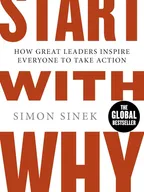
🔬 What is Start with Why by Simon Sinek about?
Start with Why is a transformative leadership book that explores the fundamental question of purpose in business and life. Simon Sinek introduces the revolutionary Golden Circle framework, which consists of three circles: Why (purpose), How (process), and What (product). The book argues that the most successful leaders and organizations don’t start with what they do or how they do it, but with why they do it—their core belief, cause, or purpose.
The central premise is that people don’t buy what you do; they buy why you do it. Great leaders like Martin Luther King Jr., Steve Jobs, and the Wright Brothers all started with a clear sense of purpose that inspired others to follow them not because they had to, but because they wanted to. The book demonstrates how starting with why creates trust, loyalty, and long-term success rather than relying on manipulation through price, promotions, or fear.
🚀 The Book in 3 Sentences
- Great leaders and organizations inspire action by starting with their “Why”—their purpose, cause, or belief—rather than focusing on what they do or how they do it.
- People are drawn to leaders and companies that communicate their beliefs authentically, creating emotional connections that foster loyalty and trust beyond any product features or competitive advantages.
- The Golden Circle framework (Why-How-What) provides a practical foundation for leadership that moves people to action through inspiration rather than manipulation.
🎨 Impressions
I first came across Simon Sinek’s video on YouTube about Start with Why, and it completely opened my mind to the universal power of asking “why.” This concept isn’t limited to one area—it applies to every aspect of life. So when I found out that Simon had written a book on the topic, I immediately added it to my cart and bought it as soon as I could. It’s truly a must-read. While most of the examples focus on business, the book actually speaks to a deeper truth that touches the very core of life.
☘️ How the Book Changed Me
How my life/behavior/thoughts/ideas have changed as a result of reading the book.
Halfway through reading this book, I realized that I’ve been feeling a bit lost in life. These days, I often get caught up in routines—work, family responsibilities, caring for my kids—but I’ve been going through them without a clear “why.” Maybe that’s one of the reasons I sometimes lose focus at work, get bored easily, or even become quick to anger when taking care of my children.
I remembered back in college, when I was active in a student organization. I would work tirelessly toward one goal: helping members grow and become intellectuals. Back then, my “why” was so strong that I made sacrifices without ever feeling like I was losing anything. That sense of purpose is what I’ve been missing, and I haven’t found it yet in my adult life.
Reading this book has pushed me to reflect more deeply on what my “why” is now, and what I should be aiming for. I know I need clarity, because finding my “why” feels vital for the rest of my life. I hope I can discover it soon.
👤 Who Should Read It?
Start with Why is essential reading for several key audiences:
- Business Leaders and Entrepreneurs: The book is specifically targeted at people in leadership positions who want to discover how to inspire teams, build loyal customer bases, and create sustainable competitive advantages.
- Managers and Team Leaders: Anyone responsible for motivating teams, from middle managers to executives, will benefit from understanding how to inspire rather than manipulate their workforce.
- Anyone Seeking Purpose: Beyond business applications, the book serves anyone “looking for a deeper sense of purpose in their work” and those who want to “wake up feeling fulfilled by the work they do”.
✍️ My Top 3 Quotes from Start with Why
You don’t hire for skills, you hire for attitude. You can always teach skills.
The role of a leader is not to come up with all the great ideas. The role of a leader is to create an environment in which great ideas can happen.
When we tell people to do their jobs, we get workers. When we trust people to get the job done, we get leaders.
🌟 My Start with Why Review
I rate it 7/10. I recommend reading it.
📒 Start with Why Chapter Summary + Notes
Part 1: A World That Doesn’t Start with Why
Chapter 1: Assume You Know
Sinek opens with the story of American versus Japanese car manufacturing, illustrating how assumptions affect our approach to problems. American workers use rubber mallets to fix door alignment issues, while Japanese engineers design doors to fit perfectly from the start. This metaphor introduces two types of leaders: those who manipulate to achieve results and those who design systems that naturally produce desired outcomes.
Chapter 2: Carrots and Sticks
This chapter explores the two primary methods of influencing behavior: manipulation and inspiration. Manipulation includes tactics like pricing, promotions, fear, aspirations, peer pressure, and novelty. While these methods work short-term, they create cycles of dependency and don’t build genuine loyalty. The chapter establishes that manipulation leads to stress and unsustainable business practices.
Part 2: An Alternative Perspective
Chapter 3: The Golden Circle
Sinek introduces his breakthrough concept: the Golden Circle consisting of Why (purpose), How (process), and What (product). Most organizations communicate from the outside in (What → How → Why), but inspiring leaders work from the inside out (Why → How → What). Apple serves as the primary example, showing how they communicate their belief in challenging the status quo before describing their products.
Chapter 4: This Is Not Opinion, This Is Biology
The Golden Circle aligns with brain biology. The “What” corresponds to the neocortex (rational thought and language), while “Why” and “How” align with the limbic system (emotions and decision-making). This explains why decisions often “feel right” even when we can’t articulate why. The chapter provides scientific backing for why starting with purpose is more effective than logical arguments alone.
Chapter 5: Clarity, Discipline, and Consistency
For the Golden Circle to work effectively, organizations need three essential elements. Clarity means having a clear understanding of your Why. Discipline involves ensuring all actions and decisions align with your Why. Consistency requires that everything you say and do proves what you believe. Without these three elements, the Golden Circle loses its power to inspire.
Part 3: Leaders Need a Following
Chapter 6: The Emergence of Trust
Trust emerges when people believe you share their values and beliefs. Leaders who start with Why attract followers who believe what they believe, creating natural trust without manipulation. This chapter explains how trust forms the foundation of all great leadership and sustainable business relationships.
Chapter 7: How a Tipping Point Tips
Sinek explains how ideas spread through populations using the innovation adoption curve. The key is reaching the early adopters (approximately 13.5% of the market) who believe what you believe. These early adopters then influence the early majority, creating the tipping point for mass adoption. Success comes from attracting believers, not just customers.
Chapter 8: Start with Why, But Know How
While Why provides the purpose, How represents the values and actions that bring the Why to life. This chapter emphasizes that successful organizations need both visionary leaders (Why) and operational leaders (How). The Wright Brothers succeeded because they had both the dream and the practical skills to execute it.
Part 4: How to Rally Those Who Believe
Chapter 9: Know Why, Know How, Then What?
This chapter explores the relationship between the three levels of the Golden Circle. What serves as the proof of your Why—the tangible products or services that demonstrate your beliefs. Organizations must ensure their What authentically represents their Why to maintain credibility and trust.
Chapter 10: Communication Is Not About Speaking, It’s About Listening
Effective communication starts with understanding your audience’s beliefs and values. Leaders must listen to discover what resonates with their followers rather than simply broadcasting their message. This chapter emphasizes the importance of finding people who already believe what you believe.
Part 5: The Biggest Challenge Is Success
Chapter 11: When Why Goes Fuzzy
Success can be dangerous when organizations lose sight of their original purpose. Sinek uses examples like Volkswagen’s expensive Phaeton (which contradicted their “people’s car” identity) and Walmart’s transformation from helping communities to purely focusing on low prices. When Why becomes unclear, organizations resort to manipulation and lose their authentic connection with customers.
Chapter 12: Split Happens
This chapter examines what happens when organizations grow and the original Why becomes diluted. Most companies start with passionate ideas but struggle to maintain that passion as they scale. The chapter discusses how successful organizations maintain their Why through structure and clear communication.
Part 6: Discover Why
Chapter 13: The Origins of a Why
Finding your Why is “a process of discovery, not invention”. It comes from looking inward at your beliefs and values rather than conducting market research or customer surveys. Your Why already exists within you; the challenge is articulating it clearly. This chapter provides guidance on discovering your authentic purpose.
Chapter 14: The New Competition
The final chapter reframes competition from beating others to competing against yourself. When you compete against everyone else, no one wants to help you; when you compete against yourself, everyone wants to help you. Great organizations focus on being better than they were yesterday rather than simply outperforming competitors.